
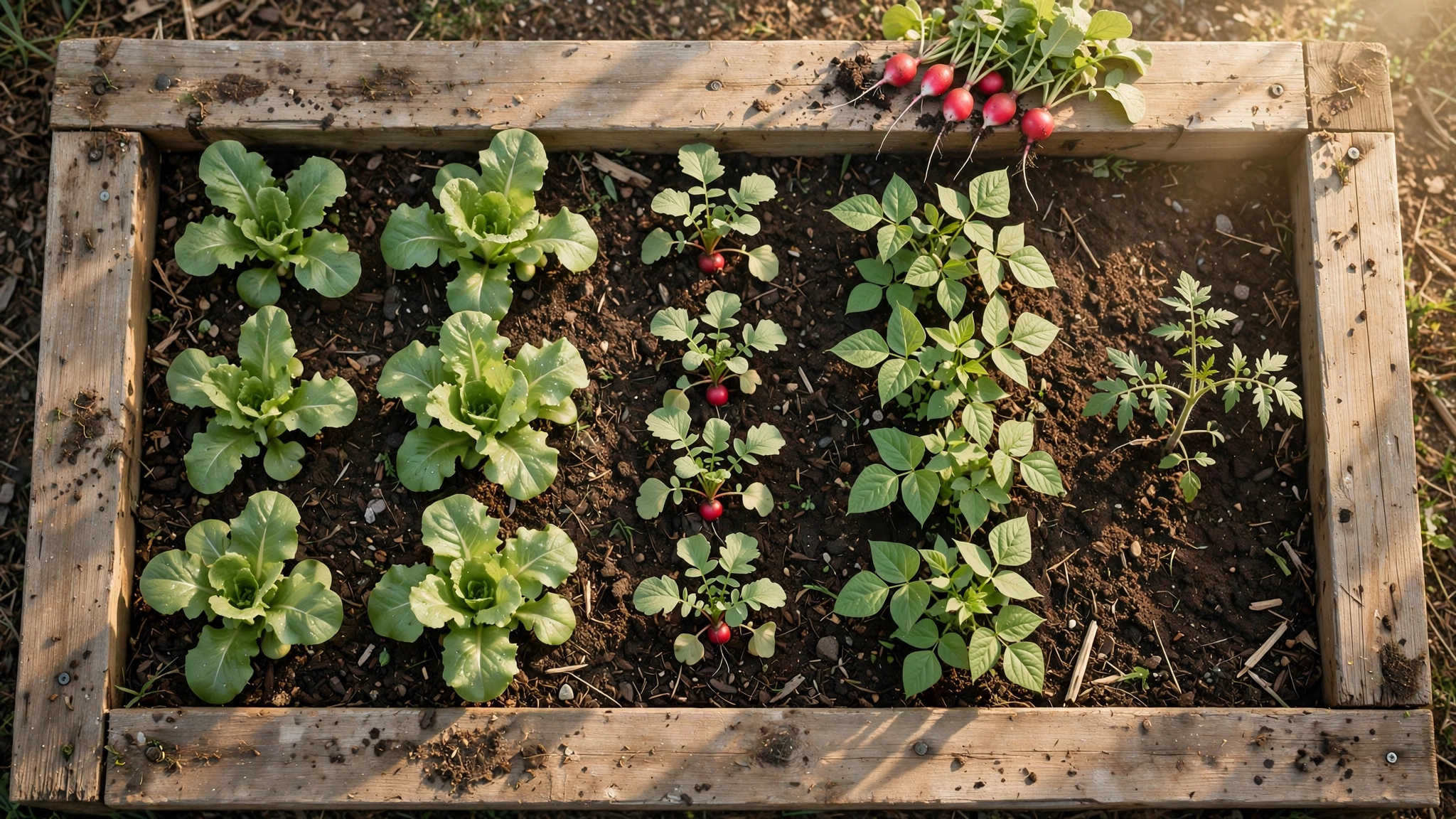
You do not need a green thumb to grow your first vegetables. You need a sunny spot, a small patch of soil or a few pots, and crops that forgive a missed watering or a slightly early planting.
Every list of "easy" vegetables has a catch, though. A crop that sails along in Georgia can struggle in a Montana summer, and the best month to plant lettuce in Arizona is not the best month in Vermont. This guide gives you ten beginner-friendly vegetables that university extension programs and gardening publishers commonly recommend, then shows you how to fit them to your own region and season.
Start with the season, not the calendar date
Vegetables fall into two broad groups, and knowing which is which does more for a first garden than any planting chart.
- Cool-season vegetables grow well in early spring and fall. NC State Extension describes them as cold-hardy crops that thrive when temperatures are below about 70°F. Lettuce, radishes, peas, beets, carrots, kale, chard, and spinach are in this group.
- Warm-season vegetables are frost sensitive. NC State Extension says to plant them after the last spring frost, once the soil has warmed up. Beans, squash, tomatoes, peppers, and cucumbers belong here.
When summer heat arrives, cool-season crops tend to bolt, which means they send up flowers and stop making tasty leaves. That is why many gardeners plant them again in late summer for a fall harvest.
Five cool-season vegetables for new gardeners
1. Lettuce
Lettuce sits at the top of many beginner lists, including the Old Farmer's Almanac's top 10 easiest vegetables. It grows well in containers, and NC State Extension notes you can grow enough for a salad in a 12-inch pot on a back deck. Leafy crops can get by on as little as six hours of sun, though they do better with eight or more. Expect it to prefer cooler weather and to fade in a hot summer.
2. Radishes
Radishes are sown directly into the soil from seed, so there are no seedlings to buy or babysit. They are a good confidence builder because you get to pull something from the ground quickly and see that you can do this. NC State Extension lists them as a cool-season crop and as a root crop that can manage with about six hours of sun.
3. Leafy greens: chard, kale, or spinach
The Almanac groups chard, spinach, and kale together as one easy pick. Choose the one you will actually eat. Be aware that heat matters here: New Mexico State University notes that kale does not fare well in hot-summer areas such as Roswell. In a hot climate, aim for the cooler parts of the year, or give greens afternoon shade.
4. Peas
Peas are a cool-season crop that you sow in the garden early in the season. They are a good fit for gardeners in colder regions, where warm-season crops have to wait. NC State Extension also lists peas among the vegetables that do well in containers, and trellises give climbing types room to grow without taking over your bed.
5. Beets and carrots
Both appear on the Almanac's easy list, and both are cool-season root crops according to NC State Extension. NC State also lists them as container-friendly, so a deep pot works if you have no garden bed. Give them loose, well-drained soil and plan to sow them in the cooler parts of your growing year.
Give long roots room to grow. Carrots and other long-rooted crops need loose, deep soil, because roots that meet rocks or hard-packed ground can fork. West Virginia University Extension says carrots need loose soil at least 8 inches deep for full root expansion, and advises loosening the soil at least 2 inches deeper than the full length of your variety. The right depth depends on the crop and variety, so check the seed packet for the mature root length. Before sowing, remove rocks and mix in compost. In a container, choose a pot deep enough for the variety you plant.
Five warm-season vegetables for new gardeners
6. Green beans
Green beans are on almost every beginner list. They are warm-season plants, so wait until after your last spring frost and until the soil has warmed. They grow in containers too, and trellises can add growing space for climbing types. For gardeners in much of the country, they are a good first warm-season crop.
7. Zucchini
Zucchini and other summer squash also appear on the Almanac's top 10 list. Like other fruiting crops, squash does best with plenty of sun: NC State Extension says fruiting vegetables need at least eight hours and do better with ten. A single healthy plant takes up real room, so a first garden does not need many.
8. Tomatoes (from nursery plants)
The Almanac specifically recommends beginners start tomatoes as transplants, meaning small nursery plants, rather than from seed. New Mexico State University makes a similar point about transplants: starting your own takes intensive management, so most gardeners prefer to buy them from a local nursery. Plant after your last frost date, and give them a spot with lots of sun.
9. Peppers (from nursery plants)
Peppers follow the same pattern as tomatoes. The Almanac lists them as a crop best started from transplants, and NC State Extension lists them as a warm-season crop that also does well in containers. Plant them after your last frost, in a sunny spot.
10. Cucumbers
NC State Extension includes cucumbers among its warm-season crops and its container vegetables. If you grow them upward on a trellis, they use less ground than sprawling vines do. Like tomatoes and squash, they ask for a full day of sun.
How your region changes the list
The ten vegetables above are broadly recommended, but your climate decides when each one belongs in the ground. Extension services say this plainly: for specific planting dates, check with your local office.
- Long, hot summers: Cool-season crops may have a short spring window and a longer fall one. Plan for shade or morning-only sun for greens in midsummer.
- Short growing seasons: New Mexico State University points out that growing-season length largely determines what a home garden can grow. Okra and watermelons, for example, have difficulty maturing in short-season areas. Quick crops like lettuce, radishes, and peas make good first choices.
- Mild winters: Some gardeners can grow cool-season crops through fall and winter. NC State Extension notes that hardy crops such as kale, collards, and turnip greens planted in fall may live through the winter.
- Microclimates: New Mexico State University says gardens within the same zone can vary by as much as 20 days because of elevation, exposure, soil type, and cold air that settles in low spots. Your yard may not match the average for your town.
Find your own timing
Start with your average last spring frost date, which tells you when warm-season crops can safely go outdoors. The Old Farmer's Almanac offers a frost date lookup by ZIP code, and your state's Cooperative Extension service can give you a local planting calendar. Soil temperature is a useful second check, since each crop has its own germination range.
GardenGuide's State-by-State Garden Guide offers regional summaries to help you get oriented. Treat them as a starting point and confirm exact dates with your local extension office.
Keep your first garden small
Several of the sources agree on this one point: begin small. The Almanac suggests a 4x4 or 4x8 raised bed, or a 10x10-foot in-ground plot, with three to five vegetables. NC State Extension adds that you should plant only the space you can manage joyfully, and expand as your skills grow. It also notes that one 4x8 bed can supply a good portion of the produce for one or two people when planned well.
A few habits protect that first season:
- Grow what you like to eat. A vegetable you enjoy is one you will remember to harvest.
- Check your sun. Most vegetables want at least six to eight hours of direct sun. Fruiting crops want more.
- Water the soil, not the leaves. NC State Extension says vegetables need about an inch of water per week on average, counting rain, and that watering the soil helps avoid diseases spread by splashing. Containers and raised beds dry out faster, so check them more often.
- Add compost before planting, and consider a soil test to learn your nutrient levels and pH.
- Stagger your plantings. Sow a little lettuce or radishes every few weeks, instead of everything on one day.
A simple way to choose your first five
- Pick two cool-season crops you like, such as lettuce and radishes, to start in your region's cool window.
- Pick two or three warm-season crops, such as bush beans, a tomato plant, and a zucchini, for after your last frost.
- Match each crop to your sun. Put fruiting crops in your sunniest spot and leafy greens where they can take a little shade.
- Write down your planting dates once you have confirmed them locally, so next year's garden is easier.
Sources
- NC State Extension, Vegetable Gardening: A Beginner's Guide
- New Mexico State University, Home Vegetable Gardening in New Mexico (Circular 457)
- West Virginia University Extension, Growing Carrots in West Virginia
- The Old Farmer's Almanac, How to Start a Vegetable Garden
- University of Maryland Extension, When to Plant Vegetables (an example of a state-specific planting calendar)
Gardening advice varies by location. Use this article as a place to begin, and rely on your local Cooperative Extension office for dates and varieties that suit your area.
